
Rummaging through my garage, I found a box of old notebooks. One of them has three pages dated 11 April 2005.
I’d been in a seminar. I have no memory of what the seminar was about (probably some boring corporate stuff) and I’d clearly stopped listening early. What I did instead, over about an hour, was work out how to tell whether a list of numbers had come from a polynomial — and if so, which one.
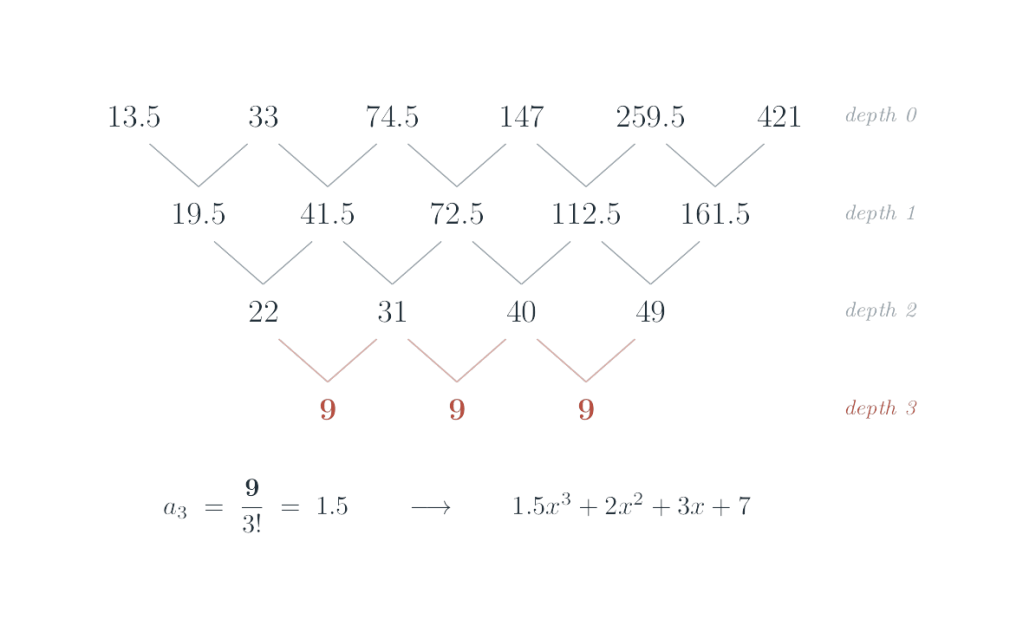
The method goes like this. Write the numbers in a row. Difference each neighbouring pair to get a shorter row. Do it again. Keep going until the row is constant. The number of passes gives you the degree; that constant, divided by the same number factorial, gives you the leading coefficient. Subtract the term off and go round again for the next one down.
So 13.5, 33, 74.5, 147, 259.5, 421 collapses to 9, 9, 9 after three passes. 9 ÷ 3! = 1.5. Peel off 1.5x³, repeat, and out comes 1.5x³ + 2x² + 3x + 7.
Which is correct. Claude and I checked, twenty-one years late. The arithmetic holds and so does the method.
Then we went looking for whoever got there first, because I’d written, in that same hour, “I am sure this has been considered by someone else many moons ago.” Fair — though centuries would have been a better word than moons.
It’s Newton and Gregory, in the 1670s and 80s. Not Babbage, which is where I’d have guessed: Babbage’s Difference Engine ran the same idea forwards, grinding out tables from differences it already had. I was running it backwards, recovering the polynomial from its output. The engine isn’t the theorem.
Just because people did it 300 years before doesn’t make me wrong. I did this from scratch — no Wikipedia, no Google, just a biro (remember those?) and a seminar I’d disengaged from. Looking a thing up and reconstructing it are different exercises, and only one of them tells you whether you understood it.
And I’d signed off with one more line: “I think this process is ‘Maclaurin in reverse’!”
Colin Maclaurin — Scot, mathematician, dead since 1746 — has his name on the series you get when you expand a function around zero. What I had no way of knowing without leaving that seminar is that Brook Taylor derived the whole family of those series from the calculus of finite differences, in 1715. The discrete came first. The smooth version fell out of it as a limit.
Which makes that line less a quip than a conjecture. And a correct one — more or less a statement of Newton’s forward-difference formula, arrived at by someone who was bored.
No McLaren in the garage, then. But a Maclaurin appreciates.
Full write-up, with the proof I said would “have to wait for a bit”

