
Last time I mentioned there was a second notebook, on a Hamiltonian for two molecular fragments. Here it is: sixty-two pages, 1996, same first year of doctoral study.
This one isn’t mine in any originating sense, and the first page says so. The Hamiltonian belongs to Brocks, van der Avoird, Sutcliffe and Tennyson, who published it in Molecular Physics in 1983. What the notebook contains is a reconstruction of it, from the beginning, by someone who had decided that reading it was not going to be enough.
The problem is two molecules coming apart. You want to track how each fragment tumbles and how they orbit one another, without hauling around every coordinate in the system. The trick Brocks and company use is to nail your reference frame to the line joining the two centres of mass. That costs you one of the three angles you’d normally need and buys an enormous simplification.
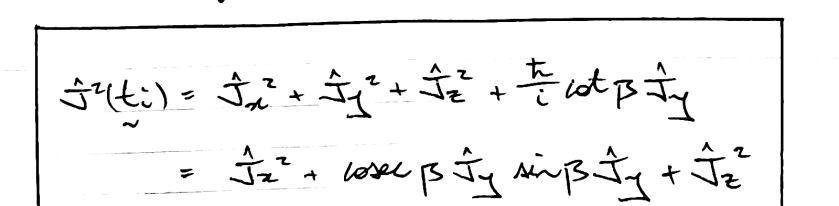
It also breaks something. The total angular momentum you get out of that frame isn’t angular momentum. Its components don’t commute the way they must. Its square isn’t the sum of its squares. It looks like the real thing and behaves like the real thing in most of the places you’d check, and then it doesn’t.
On page thirty-seven the kid notices. He writes down both failures, cites the appendix where the original authors say the same, and gives the object a name — a pseudo-angular momentum operator. Then, against the second failure, he writes see later.
Fourteen pages on, he comes back and proves it. Fifty-four terms, which he expands by hand, and which collapse to four. The square differs from the sum of squares by exactly one stray term, and that term turns out to be absorbable: wedge a sine between the two halves of the middle factor and the discrepancy regenerates itself for free. The anomaly isn’t an anomaly. It’s the weight that belongs to the coordinates, showing up as a correction because he’d written the operator without it.
I would believe a twenty-one-year-old who spotted the problem. I am less sure I’d believe one who flagged it forward and then kept the appointment.
Claude and I checked the whole thing, thirty years late — read every line, re-derive it independently, don’t accept a result because the next page assumes it.
Nine slips in sixty-two pages, and they’re all one kind of slip. A symbol goes missing in transit: three dropped squares on page three, a minus sign mislaid on page ten, an ħ/i that falls off a summary line. In every case the next line has it back. Nothing is ever wrong for longer than it takes to write the following equation.
One exception, on page fifty-seven, where a factor of two gets carried twice into a boxed result and stays there. It didn’t reach print; the published version has it right.
There are four places where he’s gone back to a finished page, found a slip, struck it out — and then, not trusting the strike-out, written the correction again on the facing blank page with an arrow pointing at it. (!) should read. There was no marker, no supervisor, no deadline, and no reader. He corrected himself twice anyway.
The notebook ends with a target rather than a result: the Schrödinger equation for the unimolecular dissociation of ketene may be attacked. Then QED, double-underlined, which is a confident thing to write at the end of something nobody was going to see.
Three years later that Hamiltonian is equation (1) of a paper in the Journal of Chemical Physics with my name on it. I checked this week, out of curiosity. The last box in the notebook, restricted to the case the paper actually computes, reduces to the paper’s equation (7).
The notebook is a PDF now.
Last time I asked whether this sort of work was necessary or whether it was ritual, and said I hoped the answer was that people still do it.
This notebook answers the question, at least for me. The Krylov one made me competent and never appeared anywhere. This one made me competent and then turned straight into a paper — not because re-deriving a published Hamiltonian is publishable, but because somebody had to take a general result for two rigid fragments and bend it around methylene and carbon monoxide in particular. You can only bend something you have taken apart.
So it wasn’t ritual. It was the load-bearing part, and it’s completely invisible in the output. The paper cites Brocks et al., as it should. The sixty-two pages that made the citation usable appear nowhere, and in the ordinary run of things they go into a box in a garage and then into landfill.
What I keep returning to is the see later. He wrote a note to a version of himself fourteen pages in the future and that version turned up. Thirty years on I’ve done the same thing from much further away, and found him waiting, having left the working out where I’d find it.

